
Large-item hauling apps and Spark top the food and grocery delivery pay charts, with median hourly figures near $23 to $38 versus roughly $11 to $15 for classic restaurant apps like DoorDash. Grubhub and Uber Eats lead the restaurant category on tip share and total hourly pay. For drivers open to a different economic model entirely, Halen's subscription structure, where you keep 100% of fares minus third-party fees, is worth testing alongside your usual apps.
TL;DR:
- Grocery and hauling delivery apps like Spark and Dolly pay significantly higher median hourly rates, often exceeding $23 to $45 per hour, but require specific vehicles or physical effort.
- Tip share heavily influences total hourly pay on platforms like Grubhub, which often surpasses restaurant-only apps due to higher customer gratuities.
- After expenses, such as mileage and fuel, net earnings can drop substantially below gross pay figures, making real-time tracking essential for accurate income assessment.
- Testing multiple apps over a two-week period yields the most accurate comparison, with peak dinner hours and tip-heavy platforms offering the best opportunities.
- Halen's subscription model, which charges a flat weekly fee and keeps drivers 100% of fares minus third-party fees, could favor steady-hour drivers over traditional commission-based apps.
Table of Contents
- What Are the Highest Paying Food Delivery Apps Right Now?
- How Does Gross Pay Turn Into Real Take-Home Earnings?
- How Do You Choose and Optimize Delivery Apps for Higher Pay?
- Where Do These Pay Figures Actually Come From?
- Halen's Take on Changing Driver Economics
- What the Data Actually Tells You to Do
- Ready to Test a Different Pay Model?
- Sources
- FAQ
What Are the Highest Paying Food Delivery Apps Right Now?
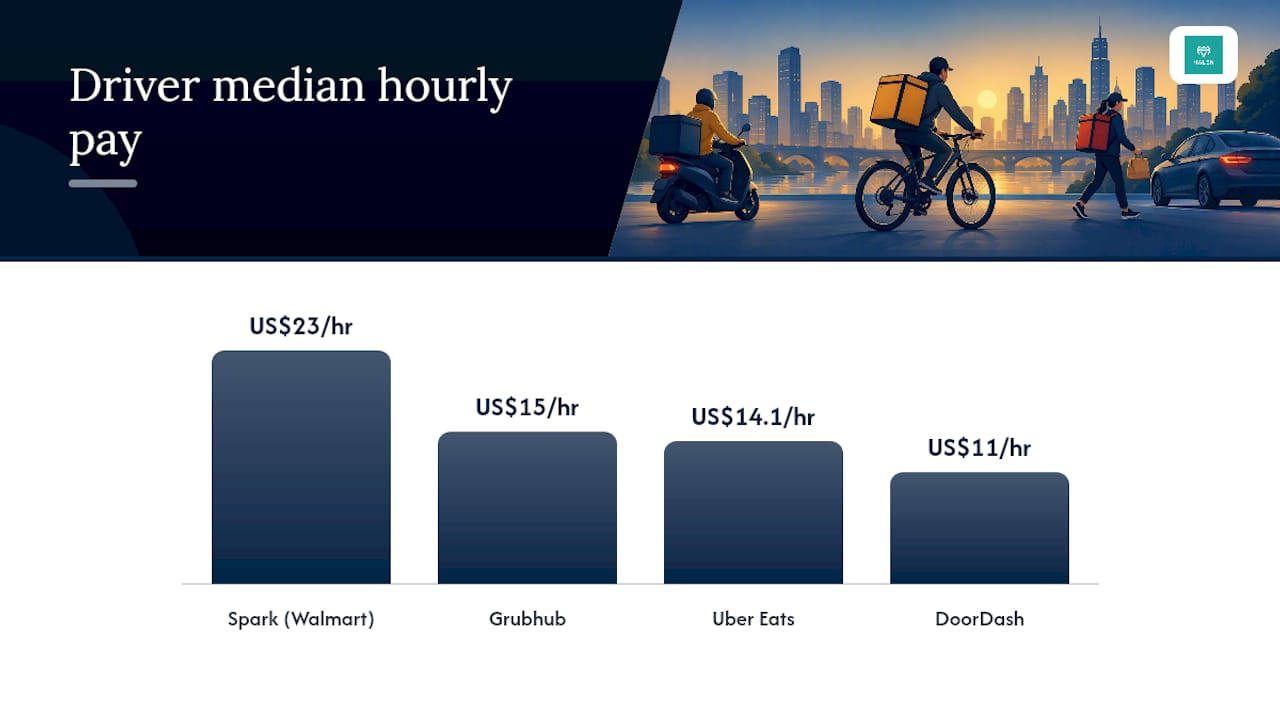
If you're chasing the biggest number on your weekly payout screen, category matters more than brand loyalty. Gridwise's driver-tracked data puts Uber Eats at a median of about $14.07 an hour in total trip pay, with average pay climbing to $18.06 once tips and incentives factor in. Grubhub tends to edge past that median thanks to stronger tip contributions in many markets. Business Insider's roundup of Gridwise data found an even wider gap once you step outside pure restaurant delivery: Spark drivers reported around $23 an hour, while DoorDash landed near the bottom of that same dataset at roughly $11.
Here's the shortlist, ranked by what actually shows up in driver-reported pay data rather than app-store marketing copy.
- Spark (Walmart) pays some of the highest medians in the retail delivery space, but it locks you into scheduled shifts and specific vehicle requirements.
- Grubhub leans on tip share more than any other restaurant app, which rewards drivers who work dinner and weekend blocks.
- Uber Eats delivers the most consistent per-hour throughput in dense urban markets, where short trips stack quickly.
- Instacart shopper blocks pay well for drivers willing to actually walk the aisles, not just drive.
- Amazon Flex offers guaranteed block pay, which is attractive when blocks are actually available in your area.
- DoorDash wins on order volume and market coverage but trails most competitors on median hourly pay.
- Caviar, now folded largely into DoorDash's infrastructure in many markets, offers a narrower footprint with less independent pay data.
- Postmates, similarly absorbed into Uber's ecosystem, functions more as a legacy brand than a standalone earnings option today.
- Shipt pays comparably to Instacart for grocery shopping work, with membership-driven order flow.
- Bungii, Roadie, GoShare, and Dolly all specialize in large-item and hauling deliveries, the category Dropcurb's 2026 roundup found, paying $25 to $45 or more per hour](https://dropcurb.com/blog/highest-paying-delivery-app) because jobs demand a truck or van and more physical effort.
- Point Pickup and Veho run retail and parcel routes for major retailers, often with block-style scheduling similar to Flex.
- Halen takes a different approach entirely: instead of a per-order commission, you pay a flat weekly platform fee and keep 100% of your fares minus third-party fees.
| Platform | Median/avg hourly pay | Typical tip share | Activation time | Vehicle fit | Order density | After-expense estimate* |
|---|---|---|---|---|---|---|
| Halen | Fares kept 100% minus third-party fees | Varies by market | Not yet publicly listed | Standard vehicle | Urban, Philadelphia launch | Depends on fare volume |
| DoorDash | ~$11/hr (avg, per Business Insider) | Moderate | Same day | Car, bike in dense cities | High volume, suburban strong | Lower after mileage |
| Uber Eats | $14.07/hr median, $18.06 avg | Moderate to high | Same day | Car, scooter, bike | High density, urban | Moderate after mileage |
| Grubhub | ~$15/hr median | High | 24+ hours | Car, bike | Urban and suburban | Moderate to strong |
| Instacart | Block pay plus per-order tips | High on large orders | 24+ hours | Car with cargo space | Suburban strong | Strong for larger orders |
| Amazon Flex | Guaranteed block rate | Low (no tipping norm) | Days to weeks (waitlist common) | Car or van | Suburban, warehouse routes | Predictable per block |
| Spark (Walmart) | ~$23/hr (per Business Insider) | Low to moderate | 24+ hours | Car or van | Suburban, scheduled shifts | Strong |
| Shipt | Comparable to Instacart | High on large orders | 24+ hours | Car with cargo space | Suburban strong | Strong for larger orders |
| Bungii, Roadie, GoShare, Dolly | $25 to $45+/hr (hauling category, per Dropcurb) | Moderate | Varies, often longer vetting | Truck or van required | Suburban, appointment-based | Strong despite mileage |
*Estimates use 2026 IRS mileage rates and vary heavily by local gas prices, vehicle type, and route density.
Pro Tip: Don't judge a platform by its advertised top earnings. Pull up your own last two weeks of trip history in each app you've used and compare actual per-hour totals before committing your primary hours to one platform.
How Does Gross Pay Turn Into Real Take-Home Earnings?
Every headline hourly figure you see is built from three pieces: base pay, tips, and promotional bonuses. Base pay is the platform's algorithmic offer for the trip. Tips can double or triple that base on a good order, especially on Grubhub, where tip share runs notably higher than on other apps. Promos, like peak-pay multipliers or completion bonuses, show up unevenly and disappear the moment demand cools.
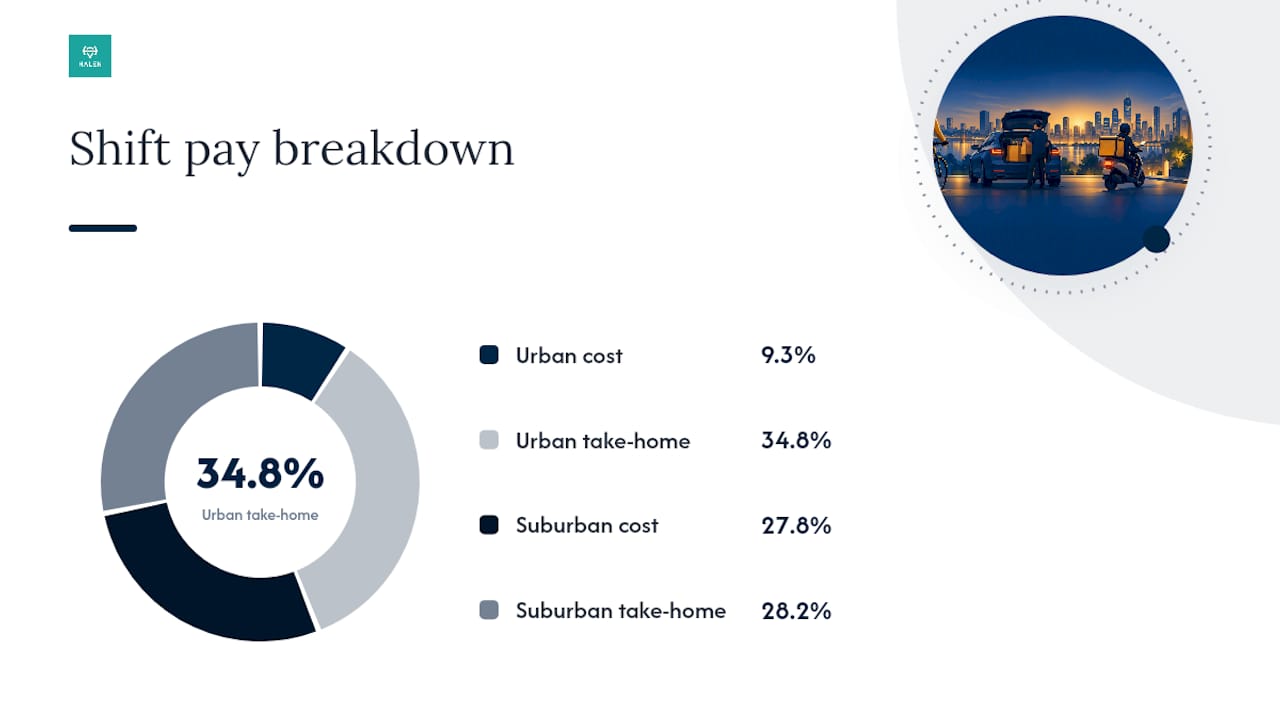
The real math only shows up after you subtract expenses. The IRS set the 2026 business standard mileage rate at 72.5 cents per mile for January through June, rising to 76 cents per mile for July through December. That rate is your simplest tool for estimating true cost per mile, covering gas, wear, and depreciation combined.
Take two drivers working an identical four-hour shift. An urban short-trip driver making $18 an hour gross on Uber Eats but only driving 20 miles in that window loses about $15.20 to vehicle costs at the second-half 2026 rate, netting close to $57 for the shift, or about $14.25 an hour after expenses. A suburban driver on Spark making $23 an hour gross but covering 60 miles in the same four hours loses about $45.60 to mileage, netting roughly $46.40, or $11.60 an hour after expenses.
| Driver profile | Gross hourly | Miles driven (4 hrs) | Mileage cost (76¢/mi) | Net hourly |
|---|---|---|---|---|
| Urban short-trip (Uber Eats) | $18 | 20 | $15.20 | ~$14.25 |
| Suburban longer-trip (Spark) | approximately $23 | 60 | $45.60 | ~$11.60 |
That flip is the whole point of comparing after-expense pay instead of the number an app shows on your dashboard. Deadhead miles, the empty driving between drop-off and your next pickup, plus parking fees and tolls in cities like Philadelphia, New York, or Chicago, can quietly erase a $5 or $10 hourly advantage that looked decisive on paper.
How Do You Choose and Optimize Delivery Apps for Higher Pay?
Treat your first two weeks on any new app as a paid experiment, not a commitment. Here's the order that works.
- Sign up for two or three apps at once rather than one, so you have real comparison data instead of guesses.
- Run a seven-day multi-app test, logging hours, miles, and net pay for each platform separately.
- Track actual after-expense earnings, not the gross number the app shows, using the mileage math above.
- Prioritize peak windows. Gridwise data shows Sunday evenings between 6 and 8pm and other weekend dinner blocks pay 20 to 30% more per hour than average weekday hours.
- Switch your primary app once one platform consistently nets you more per hour over two full weeks, not after one lucky shift.
At signup, ask about payout cadence (daily versus weekly), whether the app offers guaranteed blocks or pure on-demand orders, and what fees get deducted before you see a payout. Shopper blocks on Instacart or Shipt tend to pay more per hour than pure restaurant delivery, but they demand more physical effort and store familiarity.
Pro Tip: Stack apps strategically instead of randomly. Keep your highest-paying platform active during peak dinner hours, then switch to a grocery or retail app during slow afternoon stretches when restaurant orders dry up.
Where Do These Pay Figures Actually Come From?
The pay figures in this comparison draw from driver-reported trip data rather than platform marketing claims, which tend to advertise best-case scenarios.
- Gridwise aggregates real trip data from over 500,000 drivers, giving both median and average hourly pay by platform.
- Business Insider summarized Gridwise's cross-platform breakdown, which is how the hauling-versus-restaurant pay gap became clear.
- The IRS mileage rate anchors every after-expense calculation in this article, since it's the standard the agency itself uses for deductions.
Medians and averages tell different stories. A median shows the middle driver's experience, while an average can get pulled upward by a handful of high earners working ideal shifts. Sample sizes and local demand vary by city, so treat every figure here as a starting benchmark, then verify it against your own market before deciding where to spend your hours.
Halen's Take on Changing Driver Economics
Most delivery platforms take a commission on every single order, which means your pay ceiling is set by someone else's fee structure. Halen flips that by charging drivers a flat weekly subscription fee instead of skimming a cut from every fare. You keep 100% of what you earn minus third-party fees, whatever the trip.
Halen is building a super app for rideshare and package delivery, with food, groceries, and travel planned as it grows. The subscription model means your earnings scale with your effort, not with a commission formula working against you on every single trip.
Halen plans to launch in Philadelphia before expanding to more markets. If you're already running the after-expense math from the worked examples above, apply that same lens here: a flat fee only pays off once your fare volume clears it, so the model tends to favor drivers logging steady hours rather than occasional side trips.
What the Data Actually Tells You to Do
The conventional advice, "just drive for whichever app pays the most per delivery," misses the bigger lever entirely. Category beats brand almost every time. A driver hauling furniture on Dolly or Roadie will consistently out-earn a driver bouncing between DoorDash and Uber Eats, because the pay ceiling for restaurant delivery is capped by small order sizes and short trip distances.
The second blind spot is expenses. Most drivers chase the highest number on the app's dashboard and ignore mileage entirely, which is exactly backward. A platform advertising $23 an hour can quietly underperform one advertising $18 once deadhead miles and fuel costs land on the ledger.
What should you actually do? Run the multi-app test described above, track net pay for two full weeks, and weight your decision toward tip-heavy platforms like Grubhub or hauling apps if you have the vehicle for them. And if commission-based pay caps have been frustrating you, a subscription model like Halen's is worth testing against your current numbers, not because it's guaranteed to win, but because it changes the math in a way worth measuring for yourself.
— Halen
Ready to Test a Different Pay Model?
Every commission app you've compared above takes a cut before you see a dollar. Halen skips that entirely: pay one flat weekly fee, then keep 100% of your fares minus third-party fees, no per-order commission working against your total.

That structure rewards exactly the kind of driver this article is written for, someone tracking real hours and real net pay instead of guessing. Halen plans to launch rideshare and package delivery in Philadelphia, with food, groceries, and travel booking planned as the platform grows. If you're in or near Philadelphia and want to see how the subscription model stacks up against your current app's commission cut, check current availability and sign-up details on the Halen platform page.
Sources
- IRS: IRS sets 2026 business standard mileage rate at 72.5 cents per mile, up 25 cents
- How Much Do Uber Eats Drivers Make in 2026? (Data from 500k+ Drivers) | Blog | Gridwise
- How much Uber, Lyft, DoorDash, other gig workers made per hour in 2025 - Business Insider
FAQ
How can I make $200 a day with Uber Eats?
Hitting high daily earnings generally requires working peak windows like weekend dinner hours, when Gridwise data shows pay running 20 to 30% higher than average shifts. At an average of $18.06 an hour, you'd need to work long hours at typical rates, or somewhat fewer hours if you concentrate on peak demand and strong tips.
Which food delivery service gets paid the most?
Among food and grocery delivery apps, Spark reported medians around $23 an hour in Business Insider's Gridwise-sourced analysis, ahead of Uber Eats and Grubhub. Hauling apps like Dolly, Roadie, and GoShare pay even more, but they sit outside the restaurant delivery category and require a truck or van.
Can I make $1,000 a week with Uber Eats?
It's possible but demanding at typical Uber Eats rates. At the reported $18.06 average hourly figure, you'd need to work extensive hours, so most drivers reaching high weekly earnings are combining peak-hour focus with multi-apping across platforms like Grubhub or Spark rather than relying on one app alone.
How many deliveries do I need for $500 a week on DoorDash?
DoorDash's average hourly pay landed near $11 in Business Insider's Gridwise data, among the lower figures in that comparison. Reaching $500 typically means well over 45 hours of active delivery time, which is why many drivers pair DoorDash with a higher-paying platform like Grubhub or a subscription model like Halen to boost their weekly total.
Is Halen available for food delivery yet?
Halen is currently focused on launching rideshare and package delivery in Philadelphia, with food, groceries, and travel booking planned as the platform expands. Check the Halen site for current service availability in your area.