
"Two-hour delivery" means a retailer or delivery platform aims to get eligible items to your door within two hours of ordering, or offers a scheduled two-hour arrival window. Neither version is universal. Availability depends entirely on your address, the store or fulfillment hub serving it, and what's in stock nearby. Set your delivery address first and look for product-level "in X hours" labels before you assume anything qualifies.
TL;DR:
- Two-hour delivery eligibility depends on your specific ZIP code, store inventory, and whether products are labeled for fast shipping at checkout.
- Speed is achieved through local sourcing from nearby stores or micro-fulfillment centers, which limits assortment and can alter substitution rules.
- Confirm delivery promises at checkout, distinguishing between scheduled windows and estimated maximums, and check order cutoffs to avoid delays.
- Costs often include membership fees, per-order charges, item price premiums, service fees, and tips, making total cost comparison essential.
- Setting your delivery address before shopping ensures access to accurate fast-delivery options and eligibility information.
Table of Contents
- How Two-Hour and Other Ultrafast Delivery Options Actually Work
- Where to Find Two-Hour Delivery and How to Check Eligibility
- Costs, Fees, and Checkout Gotchas for Two-Hour Delivery
- Practical Shopper Checklist to Get the Fastest, Most Reliable Two-Hour Delivery
- How a Super App Model Like Halen Approaches Ultrafast Delivery
- Try Halen for Fast Local Delivery
- Sources
- FAQ
How Two-Hour and Other Ultrafast Delivery Options Actually Work
Ultrafast delivery isn't magic. It's math tied to geography. Retailers fulfill these orders from whatever inventory sits closest to you, whether that's a nearby retail store, a micro-fulfillment center built specifically for rapid picking, or a same-day hub stocked with a curated slice of the full catalog.
That local sourcing is exactly why the same product can show up as eligible for a neighbor three blocks away and unavailable for you. Amazon, for example, says eligible items display "in 1 hour" or "in 3 hours" labels during checkout, and customers can check their own address at amazon.com/getitfast. The company reports 1-hour delivery running in hundreds of cities and 3-hour delivery in more than 2,000, but coverage still hinges on your ZIP code and the specific hub assigned to it.
Speed comes with trade-offs shoppers often don't expect:
- Smaller assortments than standard delivery, since fast hubs can't stock everything a full warehouse carries
- Stricter substitution rules, meaning an out-of-stock item might get swapped automatically instead of refunded
- Tighter order cutoffs that can push your "two-hour" promise into the next available window
- Higher per-item pricing on some convenience-tier products
There's also a real difference between an estimated maximum and a scheduled window. "Deliver within two hours" is a target the retailer is working toward. A scheduled two-hour window, like FreshDirect's Express Delivery, is a specific block of time you select at checkout, and that service comes with a smaller assortment than standard delivery plus ZIP-code-based eligibility.
Pro Tip: Read the exact wording on the order confirmation screen, not just the marketing banner. "Arrives by 3:00 PM" is a promise. "Estimated 1 to 3 hours" is a forecast.
Where to Find Two-Hour Delivery and How to Check Eligibility
Checking eligibility takes about two minutes if you do it in the right order. Skip a step and you'll end up browsing a catalog that doesn't actually apply to your address.
- Set your delivery address before you shop. Fast-delivery catalogs, fees, and promised windows all change by location, so entering your address first is what unlocks the correct product list.
- Look for product-level fast-delivery labels or a dedicated storefront. Many retailers flag eligible items directly on the product page or route you to a separate same-day shopping experience.
- Confirm the exact promise at checkout. Read whether you're getting a scheduled window or an estimated maximum, note the order cutoff time, and check for a minimum order amount.
- Check the arrival window one more time before you pay. Reporting on Amazon's rollout notes that customers should shop within the eligible storefront rather than assume every item in a general search qualifies for fast shipping.
Retailers layer these ultrafast options over their existing same-day networks, or run them out of smaller, localized stores built to meet sub-hour promises. That's the operational reason a busy urban ZIP code often gets more options than a suburban one just twenty minutes away.
Costs, Fees, and Checkout Gotchas for Two-Hour Delivery
Speed usually costs something, and it's rarely just the delivery fee listed on the button you tap. Most services blend membership pricing with per-order charges, and the math changes depending on how often you order.
A paid membership tier typically knocks down or eliminates the per-order delivery fee, which pays off fast if you order weekly. Pay-as-you-go customers instead face a delivery charge on every order, often stacked with a smaller service fee.
Watch for these before you check out:
- Small-order fees that kick in below a minimum cart size
- Item prices that run higher on express or convenience storefronts than on standard delivery
- Service fees layered on top of the delivery fee itself
- Tip prompts that default to a percentage you may not have noticed
Some faster-than-two-hour services complicate this further. Amazon's sub-hour "Amazon Now" option, for instance, runs from specialized smaller locations and uses different fee structures for Prime members versus non-members, which means a membership that saves you money on standard orders won't necessarily apply the same way to the fastest tier.
The real comparison point isn't the delivery fee alone. McKinsey's research on U.S. e-commerce delivery preferences found that shoppers generally value reliability and total cost over raw speed, and many will happily wait several days for free shipping rather than pay a premium to shave off hours. Add up item price, delivery fee, service fee, and tip before deciding two-hour delivery is worth it for that particular order.
Practical Shopper Checklist to Get the Fastest, Most Reliable Two-Hour Delivery
A little prep work is the difference between a smooth two-hour delivery and a frustrating one that shows up late with the wrong items.
- Lock in your delivery address before browsing so the app or site shows only inventory eligible for your location.
- Choose items explicitly labeled for fast delivery, and skip anything marked as substitution-eligible if the exact product matters to you.
- Read the checkout wording closely to see whether you're getting a guaranteed window or an estimate, and note the cutoff time and any order minimum.
- Keep a backup plan ready, whether that's a later same-day slot or local pickup, in case two-hour delivery isn't available for your cart.
Pro Tip: If a fast-delivery cart shows a substitution warning on an item you need exactly as listed, split that item into a separate order or contact support before checkout. It's faster than dealing with a swap later.
How a Super App Model Like Halen Approaches Ultrafast Delivery
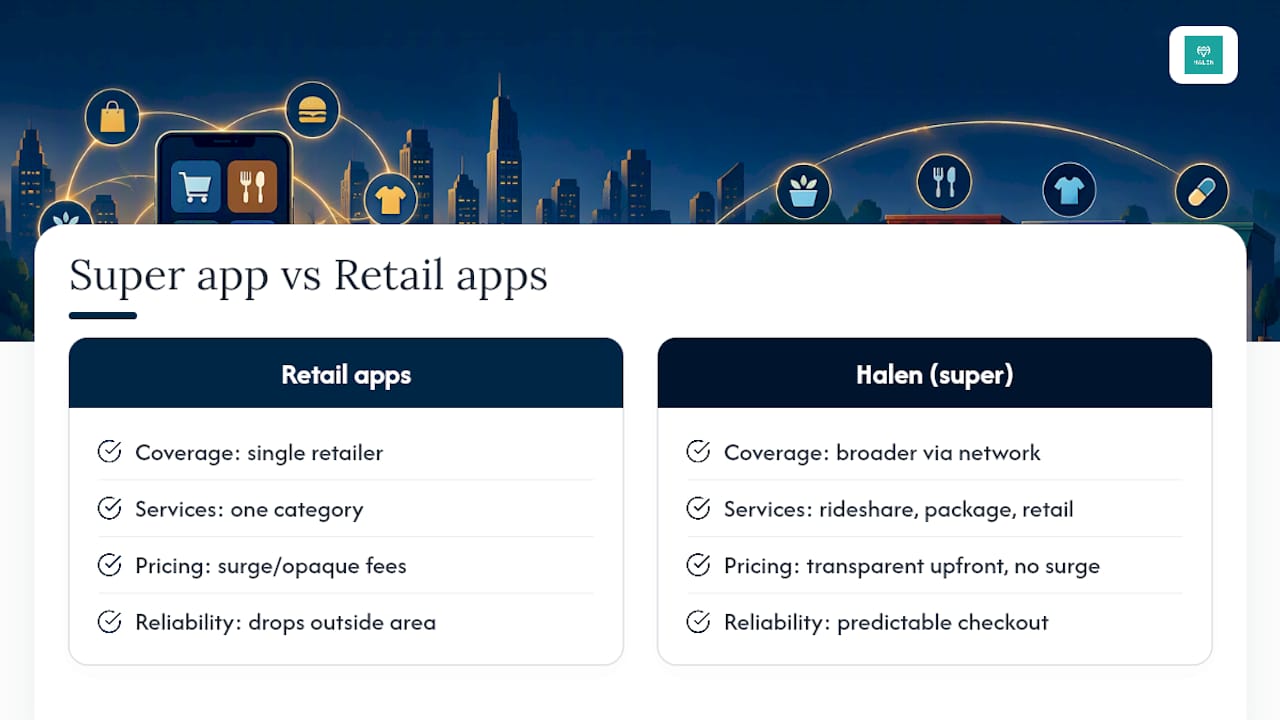
Most fast-delivery promises live inside a single retailer's app, which means your options shrink the moment that retailer doesn't serve your neighborhood. Halen takes a different approach by building one app for rideshare, package delivery, and retail delivery, with grocery and food on the roadmap.
The pricing structure is where it gets interesting. Halen runs on transparent, upfront pricing with no surge charges, so what you see before you order is what you pay. An integrated driver network paired with predictable pricing is a practical way to cut down on the checkout surprises that make ultrafast delivery feel less reliable than it's supposed to be.
— Halen
Try Halen for Fast Local Delivery
If you're tired of juggling separate apps for rides, packages, and everyday errands, Halen puts them under one roof with pricing you can actually predict before you tap "order." No surge pricing, no guessing what the final total will look like, and drivers keeping a larger portion of their fares rather than paying per-ride commissions.

Getting started takes the same first step outlined earlier in this article: set your delivery address in the Halen app and follow the prompts to see what's available near you. Because Halen is expanding market by market starting in Philadelphia, availability will grow over time, so checking your address is the fastest way to know what's live right now. Before you commit to any order, compare the full checkout total, item cost, delivery fee, and any service charges, the same way you would with any fast-delivery platform. Head to Rides, Grocery, Food delivery and more to set your address and see what's available in your area today.
Sources
- Amazon introduces faster delivery with new 1-hour and 3-hour options
- FreshDirect adds express delivery service in NYC
- What do U.S. consumers want from e-commerce deliveries
- Amazon launches 1-hour, 3-hour deliveries
FAQ
Does Amazon Have 2 Hour Delivery?
Amazon offers 1-hour and 3-hour delivery windows rather than a flat two-hour promise, and eligibility depends on your address. You can check your specific ZIP code at amazon.com/getitfast to see which speed applies to you.
How Do I Get Amazon Delivery in 2 Hours?
Set your delivery address first, then shop within the eligible storefront where items show "in 1 hour" or "in 3 hours" labels. There's no separate two-hour tier; you're choosing between the two speeds Amazon actually offers based on what's stocked near you.
Who Offers 1 Hour Delivery?
Amazon runs 1-hour delivery in hundreds of cities through its fast-delivery program, and its newer Amazon Now service pushes some orders to 30 minutes from specialized local stores. Other retailers and grocery services offer similarly fast windows, though availability always comes down to your specific address and nearby inventory. A super app model is developing toward rapid local delivery as part of a combined rideshare and package delivery platform, starting in Philadelphia.
How Much Should Delivery Cost for an Hour Delivery?
Costs vary by retailer, membership status, and order size, so there's no single standard rate. Compare the full checkout total, item price, delivery fee, service fee, and tip, rather than judging cost by the delivery fee alone, since total checkout impact matters more than the sticker price on speed.